

Family Safari in Tanzania: Planned Around Your Family

Plan your Holiday in Tanzania with peace of mind

Professional service from trusted local experts

We are proud of our service quality and great reviews

You have our support 24/7 during your tour

Prepared by Halima Msangi — Safari Consultant with more than 18 years of experience.
As a mother and safari consultant with more than 18 years of experience helping families travel in Tanzania, I understand that planning a Tanzania family safari requires a different approach from planning a trip for adults alone. Parents want their children to be excited, comfortable, safe, and engaged, while also having the opportunity to relax and enjoy the journey themselves.
A family safari in Tanzania is more than a wildlife holiday. It is an opportunity for parents and children to discover Africa together, experience wildlife in its natural environment, learn about different cultures and conservation, and share experiences that can become lifelong family memories.
At Calabash Adventures, we do not simply take a standard safari itinerary and add children to it. We plan the journey around your family from the beginning. We consider your children’s ages, personalities, interests, energy levels, previous travel experience, food preferences, sleeping arrangements, tolerance for long drives, and the type of accommodation that will make everyone comfortable.
Our approach is simple:
Good family safari planning begins before we choose the camps or decide how many nights you will spend in each park.
We first want to understand who is travelling.
A family with children aged four, eight, and fourteen may need a very different itinerary from a family travelling with teenagers. Younger children may need shorter periods in the vehicle, more opportunities to swim and rest, and activities that keep them curious. Teenagers may want greater independence, photography opportunities, longer wildlife encounters, walking experiences, or more challenging activities.
We therefore look at the whole family when planning the itinerary.
This can influence:
The goal is not to fill every day with activities. A successful family safari needs a balance between adventure, discovery, comfort, and downtime.
Children experience a safari differently when they are actively involved rather than simply being passengers in a vehicle.
Our guides help turn each game drive into an experience that children can understand and enjoy. Instead of simply pointing out an animal and naming it, an experienced guide can explain what the animal is doing, how it communicates, what it eats, where it lives, and how it survives.
A lion sighting can become a story about hunting and family groups. An elephant encounter can lead to a conversation about communication, memory, and the role of older females in the herd. Tracks in the sand can become clues that children try to identify before the guide reveals which animal passed by.
Depending on their age, children can also learn to look for birds, animal tracks, insects, plants, dung, footprints, and other signs of wildlife.
These small discoveries can make the safari much more interactive.
We believe the guide can make or break a family safari.
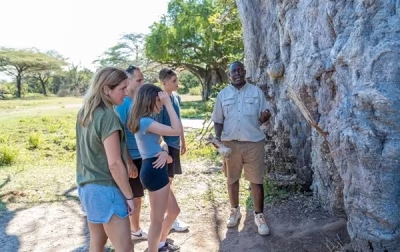
Our experienced guides do much more than drive and identify wildlife. They are interpreters of the landscape, storytellers, educators, and companions throughout the journey.
A good family guide understands when children are becoming tired and when they are fascinated. He or she knows when to slow down, when to explain something in greater detail, and when to turn an ordinary observation into an exciting story.
Our guides share stories from their own experience in the bush—about unusual animal behavior, memorable encounters, tracking wildlife, changing weather, conservation, and life around Tanzania’s protected areas.
These stories give children a connection to the place they are visiting.
Rather than simply saying, “There is a lion,” the guide can help the family understand why the lion is resting there, what it may have been doing earlier, and what might happen next.
For teenagers, the guide can go deeper into photography, animal behavior, ecosystems, conservation, tracking, and the realities of protecting Tanzania’s wildlife.
This personal interaction is one of the reasons a private safari can be so valuable for families.
Accommodation is another important part of family safari planning.
We do not choose camps and lodges simply because they are highly rated or attractive. We look at whether they actually work for your family.
Depending on the children’s ages and the availability at each property, we may consider:
For families with younger children, staying together in a family room can make nights easier and more convenient. For families travelling with teenagers, interconnected rooms or adjoining rooms can provide a useful balance between family connection and personal space.
We also discuss room-sharing arrangements before confirming the itinerary. Some families are perfectly comfortable with children sharing with parents, while older children or teenagers may prefer their own room or to share with a sibling.
The important point is that accommodation is selected as part of the family planning process, rather than treated as an afterthought.


Teenagers can sometimes be the most difficult family members to impress—and we understand that.
They may not want every day to follow the same pattern of early breakfast, long game drive, lunch, and another game drive.
We therefore look for ways to give older children and teenagers a greater sense of participation.
Depending on the itinerary, this can include wildlife photography, learning how guides track animals, bird identification, conservation discussions, cultural experiences, walking activities where permitted, swimming, and opportunities to ask the guide deeper questions about wildlife and life in Tanzania.
The guide’s storytelling is particularly important here. Teenagers often become much more engaged when they are encouraged to ask questions, make observations, use a camera, or try to predict what an animal will do next.
A safari should give them something to discover, not simply something to watch.
A family safari does not have to mean spending every waking hour inside a safari vehicle.
Depending on the children’s ages, interests, and the destinations included, we can incorporate experiences such as:
We choose activities carefully rather than adding them simply to make an itinerary look busy.
Children need time to process what they have seen. A morning game drive followed by lunch and swimming may sometimes be more enjoyable than adding another activity simply because there is an empty afternoon.
One of the biggest mistakes in family safari planning is trying to see too much in too little time.
A private safari gives us the flexibility to create a more comfortable rhythm.
We may recommend spending two or three nights in one location rather than changing camps every night. We may suggest a later start after an especially long previous day, or an afternoon focused on swimming and relaxation rather than another extended game drive.
Where practical, domestic flights can also reduce long road journeys and give families more time to enjoy their destinations.
The itinerary should have enough structure to make the journey exciting, but enough flexibility to allow your family to enjoy each day naturally.
For many families, the ideal Tanzania holiday combines safari and Zanzibar.
After several days exploring the bush, Zanzibar provides a completely different environment. Families can swim in the Indian Ocean, relax on the beach, explore Stone Town, discover local culture, enjoy water activities, or simply spend time together without a schedule.
Some families prefer a longer safari followed by several days at the beach. Others choose a shorter safari and more time in Zanzibar.
We can coordinate the safari, domestic flights, accommodation, and transfers so that the transition from the bush to the coast is comfortable and straightforward.
The best family safaris are not necessarily the ones with the most activities or the most expensive accommodation.
They are the journeys where the planning, guide, accommodation, pace, and experiences work together around the family.
It might be a child’s first elephant sighting, a teenager photographing a lion, a family learning to identify animal tracks, a guide telling a story around the campfire, or everyone laughing together after an unexpected wildlife encounter.
These are the moments that make a Tanzania family safari different from an ordinary holiday.
At Calabash Adventures, our role is to bring these elements together—from the first conversation about your children to the final transfer to the airport—so your family can experience Tanzania comfortably, confidently, and at your own pace.
Because the best family safari is not simply about where you go. It is about how the journey feels for everyone who travels with you.
“Ready to book? View our hand-crafted 12-Day Tanzania Family Safari Packages.”

Book Now & Save Big 2026

*View Available Safari Deals.